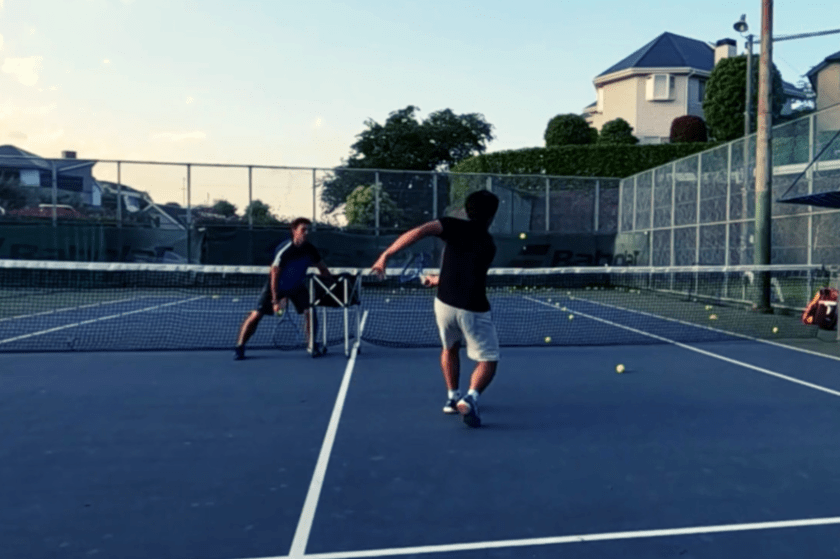
In championship tennis, like in life, a daily effort of improvement and development should not be directed towards the others. In early age of the junior development (and in early years development on the tour), players should not compare each other and value their game based on the results and the opinion of others if they performed better than their opponent. Having this kind of mindset is very closed and if the results do not come early, players could experience destructive emotions and thoughts that would lower their confidence, motivation for practicing and competing, eventually failing to become better and further improve. Of crucial importance is to be focusing on positivity and big picture rather than small negativity caused by current results or other people opinion.
BEING THE BOSS OF YOURSELF
Players facing the problems and conquering the challenges have higher chances to be satisfied with their performance and development. Hunger to stand in the face of difficulties without asking help from the parents or a coach to take care of the problem is the main driving force of players’ control and management of own development process.
Being a boss of yourself have many levels within the players. As the boss of the company, who must have completely control over the company divisions to run a successful business, players should have a complete control over all of their own divisions.
One dimensional approach to tennis development, where hours of repetition eventually build up the confidence and keep the motivation always high is perhaps too old fashioned approach. My belief is that if the junior player would like to constantly improve, the effort should come from various levels (divisions) of own body performance. True athleticism has two sides, and one is never mentioned: the inner athlete. The inner athlete has more challenges to conquer and more obstacles to bypass as the outer athlete is what is shown in public and what is visible but it is the mirror of the inner mental and physical state.
I keep on listening of the mental stamina and mental training and how to improve the game etc. We keep on admiring players like Djokovic and his mental toughness but we as mentors do not apply his choice of excellence to enhance our juniors’ development process. Still, most of the coaches rely on the on-court time and hours of repetition. Djokovic is a perfect example of being the boss of himself, and he shows that for years, constantly improving and being far better player now at this age compared to 10 years ago when he was physically in his prime.
BOSS OF OWN DEVELOPMENT
The development could high likely turn into the negative experience if focus is on the results rather than progress and development of the inner athlete. The key of the healthy and long term development is for the player to create own tennis signature, own style of thinking and approaching to tennis. The signature can refer to the technical-tactical performance or game plan, nutritional habits, off court practice or approach to tennis. The signature relates to specific player, and it is his/her responsibility to create it and grow it (with the assistance from the mentor-coach). The signature must be accepted and nurtured by the player and the player has to be loyal to that signature no matter the circumstances or situations. Loyalty to the signature no matter of opponent, score or other daily distracting factors would keep the player attentive to his game, responsible to keep adding more effort, determined to practice and play and be self-centered and fully committed to the development process. The loyalty and sticking to the signature grow the confidence in the game and the whole process of tennis development keeping players motivated to continue developing the signature to be undivided from his tennis personality and style.
BOSS OF MY WHOLE SELF
We often place our body and physical capabilities first – thinking more about an outer athlete. But physical is only one division of our development as tennis players. Other divisions that players’ need to consider are brain, heart, lungs, diaphragm, gut. When there is a mention of the wholistic approach to developing a championship athlete, usually development of these divisions building an inner athlete, adds to the visible outer athlete and the condition of his/her muscles, tendons or ligaments.
Developing brain functions are not only related to plasticity and creating solid connections with muscle tissues to perform a movement but to possibly control your own thoughts and use them wisely when in need. Players are advised to shut down the emotions so they could stay centered. It is much easier said than done.
To do so, we need to further develop, train (and understand) other powerplant divisions such are lungs, diaphragm, or gut. It is well known that certain way of attentive breathing can speed up or slow down our thoughts and prevent us from thinking in a negative or destructive ways. That can be of a crucial advantage to play better the next point which eventually can overturn the momentum of the game suddenly.
It is well known that certain food can create a spark and develop unexpected emotions while some can slow us down and keep us calm for longer period. Or that certain food can energize us for a longer or shorter period and that some can make us feel heavy and unwilling. Players need burst of energy to their mind and bodies but as good as it is, the burst can suddenly turn from having the positive to the negative influence on our bodies to perform.
It is well known that performance levels can be impaired if a player is dehydrated by as little as 2% of the body weight. Dehydration up to 5% of the body weight can even decrease body’s working capacity by 30%!
These are some of the examples of being boss of yourself and importance of managing own inner athlete. Instead of blaming the stroke or opponent, ask yourself how well you know yourself, how much time did you really tried to understand how you can improve your performance or are you aware of the ways to prevent yourself from hydrating when playing an important point. This question does not have anything to do with age, but with the true will to improve yourself wholistically.
When you fail to be satisfied with your performance next time, ask yourself how much time, besides the on court practice, did you spend in truly improving yourself!
 Play Smart Tennis - MIND YOUR GAME - Anticipate! Don’t participate