Visual search, peripheral vision, gaze in tennis, anticipation

Play Smart Tennis – MIND YOUR GAME – Anticipate! Don’t participate
by Milos Dimic, Sports Neuroscience PhD
Visual search, peripheral vision, gaze in tennis, anticipation

For a player to move the body segments efficiently, there should be optimal combination of the stability and mobility through lowering the center of gravity created by loading the major muscle groups of the lower extremities.
Upper body force creation depends of the elastic capabilities of the muscles of the trunk. The reason the players create a larger upper trunk rotation beyond the hips is to pre stretch the trunk rotator muscles and create a powerful separation angle

The hip musculature generates the majority of power for the successful stroke. In simple words, if the player uses the wrong sources of power, most likely that she/he will lose the stability and balance during the acceleration phase. As mentioned in previous blogs, the source of the power comes from the ground, and its forces. These forces are transferred from the ground to the hip muscles and core, and at this point is where rotational and linear forces work together. The transfer of energy in linear and rotational mode wouldn’t be possible without a“stiffened” core and serape musculature
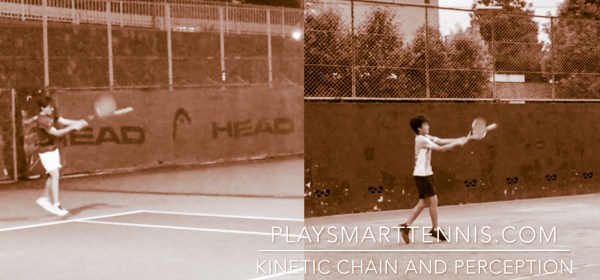
The center of the mass of the body is directly connected with the centering of the athlete’s mind. As centering of the mind makes the athlete more grounded, calm and relaxed, it lowers the levels of anxiety. Centering the thoughts, the athlete can be fully aware of the body’s position and to be exact – it’s center of mass and transfer of weight around it
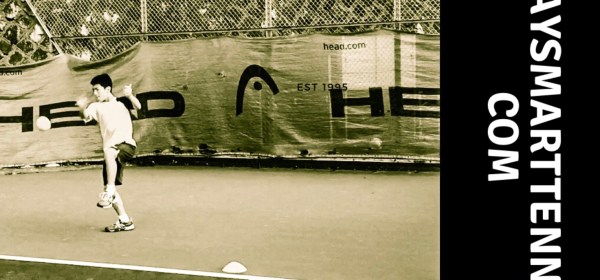
Creating a feeling of proper loading and unloading the body parts is first step in creating the awareness of the power source

Body segments must be coordinated and synchronized in such a way that a highest racquet speed is generated at the impact point.
 Play Smart Tennis - MIND YOUR GAME - Anticipate! Don’t participate