THE PERCEPTUAL-COGNITIVE GAME COMPONENT
Expertise in tennis should be considered from the aspect of detecting the most relevant cues from the environment to which the most efficient response can be initiated (Gegenfurtner et al.,2013). At the highly changeable and dynamic match environment, attending to the relevant cues enhances the reaction speed of the neural system and the speed of the movement response (Ozaki et al., 2004).
Tennis game is characterized by the short distances between contestants (baseline to baseline distance is 24 m) with players’ changeable (and unpredictable) stroke executions imposing spatiotemporal constraints on opponents’ decision-making and movement response. As reaction time presents a time spent from detecting a stimulus to creating a movement response, receivers with quicker reaction time should be able to decide and create an earlier movement response, decreasing the sense of urgency when transitioning from their current position to the position of impact. That ability could be the most important difference in tennis performance between the experts and novice tennis players (Le Runigo et al., 2005). Technical-tactical execution of the stroke should be an undoubtable marker of expertise in tennis performance, but the mechanical part of the stroke performance is highly influenced by the spatio-temporal constraints or affordances that hitter experiences when preparing to set-up for the stroke execution.
Perception can not be separated from the cognition at the game context as these abilities are coupled by previously established cognitive experiences, crucial in giving a meaning to the perceptible cues. By coupling these two components, players should increase the speed of reaction and quality of the decision making, consequently leading to the efficient split step response (Uzu et al., 2009), better court coverage (Shim et al., 2005) and advantageous tactical situations with higher affordances for the stroke execution (Dimic et al., 2022, 2024). Observers may be having an impression of players with efficient positioning to be “fast athletes” which refers to the physical abilities, but on the contrary, they should be classified as “fast decision-makers”.
IMPORTANCE OF DEVELOPING TENNIS SPECIFIC PERCEPTUAL- COGNITIVE SKILLS
The most important aspect of developing the perceptual-cognitive skills in tennis are to enable the player to adapt to the dynamical changes in the game context (decision-making) by creating the most efficient movement solution and produce behavior (movement response) that results in a successful performance outcome (stroke execution of highest affordances). The functions of the recruited muscles for the movement depend on the context in which they are used (Enoka, 1994), having the mechanics of the movement of the tennis player directly influenced by the quality of the stimulus perception and time availability in force production.
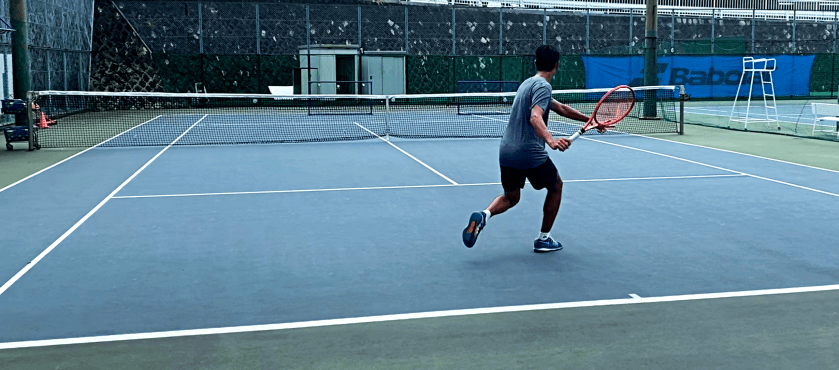
Video: Practicing without the ball can have certain advantages. Firstly, the player is attentive to the patterns of movement as response to the certain stimuli and secondly more aware of the body movement in comparison to the ball movement
Force production in tennis, as in other ground-based sports, involves the usage of the ground reaction forces in combination with gravity and inertia (Groppel, 1992; Kibler and Van der Meer, 2001). Based on the prediction of the future position of impact, player accelerates with an intention of intercepting the ball. As the player approaches the incoming ball, decelerates by planting the foot to be able to transfer the ground forces through ankle and lower extremities to the upper body. Efficient transfers are only possible if initially player read the game cues and planned the most efficient movement solution timely. From the receiver’s split step position (most common preparatory position) to the hitter’s recovery movement following the stroke execution, perceptual-cognitive abilities are guiding players’ into finding the best technical-tactical solutions for the action in hand.
Therefore, perceptual-cognitive training should enable players’ movement efficiency in all 5 phases of the tennis movement (Giles et al., 2019):
- Split step movement initiation (anticipatory (pre-impact) or reactionary (post-impact))
- Transition when intercepting the incoming ball (acceleration and upper/lower body differentiation)
- Arrival/Setting up to intercept the incoming ball (deceleration to enhance the set-up)
- Impact / Interception (stroke execution)
- Recovery (rapid and planned movement towards the best court position for the subsequent stroke).
The perceptual-cognitive training should be enhancing players’ perceptual-cognitive abilities by decreasing their visuo-motor delay and increasing movement affordances in following order:
- Enabling them to be selective and attentive to the most relevant cues in the highly challenging and dynamic match environment (Crognier & Féry, 2005; Loffing & Hagemann, 2014) and,
- Reducing their time for cognitive processing and, thus, increasing time for producing the most efficient motor action (Ward et al., 2013).
- Increasing the force application in above mentioned five phases of the tennis movement.
This could be one of the most important aspects in tennis performance when creating advantage over the point dynamics (Gilles et al., 2019; Dimic et al., 2022).
 Play Smart Tennis - MIND YOUR GAME - Anticipate! Don’t participate