ラケットのスイング段階は、サービスの運動連鎖運動のうち、以前の効率的な負荷とコッキング段階の結果です。コッキング段階では、弾性エネルギーが動きの遅い主要筋群に蓄積され、加速段階では、このエネルギーが動きの速い筋群を通じてボールに向かって放出されます。

Play Smart Tennis – MIND YOUR GAME – Anticipate! Don’t participate
by Milos Dimic, Sports Neuroscience PhD
ラケットのスイング段階は、サービスの運動連鎖運動のうち、以前の効率的な負荷とコッキング段階の結果です。コッキング段階では、弾性エネルギーが動きの遅い主要筋群に蓄積され、加速段階では、このエネルギーが動きの速い筋群を通じてボールに向かって放出されます。

サーブの運動連鎖の最初のリンクは、プレーヤーが地面を押し出すときの地面反力を利用しており、その効率は3つの関節(足首から始まり、膝関節、そして股関節)の協調的かつ同期的な伸展に依存している。同期した伸展が成功すれば、プレイヤーがインパクトの高さを上げるための直線的な運動量を生み出し、脚から腰や肩への角運動量の伝達を可能にし、ボールを介したフォワードスイングの長さを長くして、より効率的にするという重要な役割があります。また、効率的な脚の動きは、外旋・内旋段階での肩関節への負担を軽減することが証明されています。
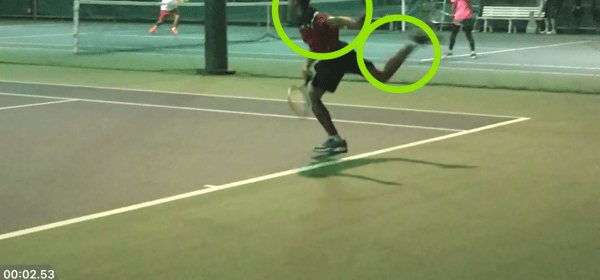
サーブモーションにおける直線的な運動量は、プレーヤーが完璧な上半身のターン(角度的な運動量)を生み出し、最も効率的なフォロースルーの動きを生み出すことができる高さに全身が達したときに達成されます。これを実現するためには、脚が腰、肩、そして腕と手首にエネルギーを伝達できるような強力なドライブを作り出す必要があります(キネティックチェーン)

Through the course of tennis history, players’ performance enhancement evolved around the strokes and its effective application for the purpose of winning points in the competitive environment. Players’ stroke execution is surely one of the most researched field in the game of tennis as all tennis players, no matter of the level of their game or competitive involvement, are mostly attentive to the stroke mechanics and consistency of their body parts movement in space and time. Players usually try to be mostly aware of their own hitting space, with a tendency to underestimate the fact that tennis is a game of movements and interactions.

Before we activate our muscle fibers to begin our movement, there is an order of things that should be done inside of our brains. No matter how it sounds, although our brain is a perfect machine that enable us to do impossible things it can inhibit us from doing things as well

Direction of the stroke is related to the timing and angle of the impact point. The unwritten rule is that the ball will be following the direction to which strings of the racquet are directed to at the point when racquet intercepts the ball. Usually, in order to perform at their best, the players change timing of torso rotation to the ball while changing direction of the stroke
 Play Smart Tennis - MIND YOUR GAME - Anticipate! Don’t participate