Tennis is a sport with a goal of creating a movement of certain pace and intensity to reach a certain interception point as a target determined by space and time (Renshaw & Davids, 2004). Tennis performance is highly affected by the ways how players apply their movement momentum to the ball that is approaching towards the future impact point.

The striking action in tennis is influenced by the preparatory phase which includes the efficiency of the receivers’ reaction and movement response. Players constantly adapt to the highly challenging situations and dynamics of the game imposed by opponents. The most important aspect of the adaptation is the reaction time. Players with a quicker reaction can make a quicker decision about the orientation and initiation of their movement, enabling balanced and timely set up to store the potential energy for efficient stroke movement.
Players constantly adapt to the highly challenging situations and dynamics of the game imposed by their opponents. The most important aspect of the adaptation is the reaction time. As reaction time presents a time spent from detecting a stimulus to creating a movement response, receivers with shorter reaction time should be able to create earlier movement response. That would enable a coverage of the wider court distances quicker and with acceptable feeling of urgency when setting up for the stroke as hitters. Le Runigo et al., (2005) stated that the crucial difference between the expert and novice tennis players is their reaction time, which should be one of the main determent of players’ expertise. Expert tennis players have shown that their visuo-motor delay is much shorter (162ms) than of the novices (221ms) enabling them to have a quicker reaction and by that, more efficient movement response.
By anticipating, receivers create earliest possible movement response initiated to correspond to the movement of the opponent, while the ball is still approaching to the impact point. They observe crucial features of the opponent’s movement as a source of predicting hitter’s stroke intentions, judging the potential affordances or limitations of the stroke that follows.
MOMENTUM AS DETERMINING FACTOR FOR STROKES POSSIBILITES
In mechanics, momentum is a vector quantity defined as the product of an object’s mass and velocity. Momentum can be particularly important in impact as the result of the impact depends on the momentum that each of the moving bodies (ball and a player) possesses (Hay and Reid, 1988). In addition, as momentum has a direction, it can be used for prediction of the resulting direction and speed of motion of moving bodies involved after they collide[1] (intercept). In this thesis, this term will be used as a general term with a meaning as:
1. An ability to keep increasing or developing[2] and
2. A quality that keeps an event developing or making progress after it has started.[3]
In competitive tennis, harnessing the forward momentum is of crucial importance in developing an aggressive stroke of high affordances in direction and intensity. Furthermore, it enables hitters to intercept the ball earlier which makes the distance between the players and ball flight time shorter, applying an additional pressure to the opponent. For these reasons, expert players’ priority is to position themselves as early as possible enabling a timely set up to intercept the ball earlier and harness the forward momentum as much as possible.
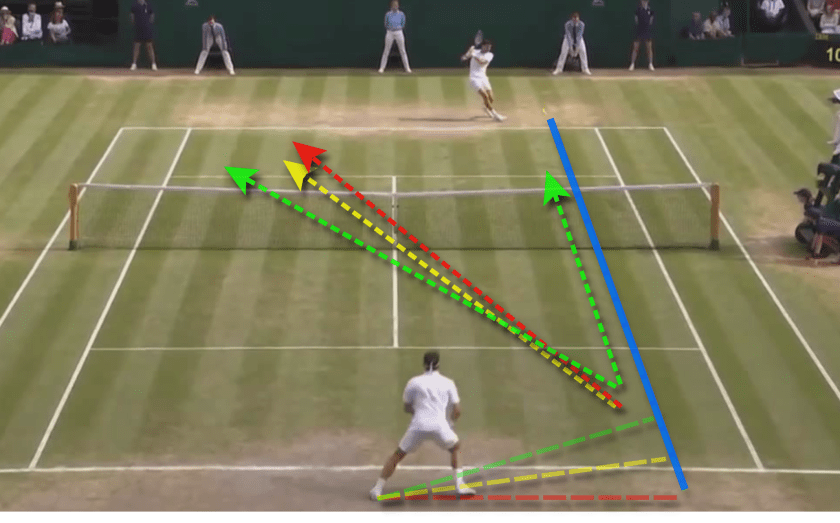
Depending on the speed of the reaction that precedes the movement response, receivers create different intensity and direction of movement response towards their future impact position (Figure 1). Figure 1 shows how could potentially reaction time influence the movement responses of a receiver (thin dotted lines) and by that, influence the point of interception and affordances or limitations in the application of the forward momentum. of the following stroke in its’ direction (thick dotted arrows). Therefore, a quicker reaction should cause quicker movement response (green as quickest) with more efficient application of the forward momentum (higher affordances in intensity and direction, green dotted arrows). Compared to the
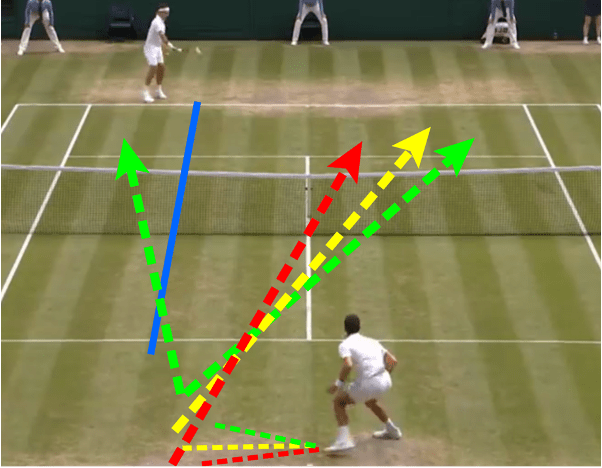
Figure 1
Hitter’s Potential Movement Response (dotted lines) intercepting the ball (blue arrow)
affordances of the earlier reaction (green), later (yellow) or delayed reactions (red as most delayed) cause more limitations.
Red lines (most delayed response): Delayed reaction causes later movement response potentially limiting the stroke options in intensity and directions with stroke forward momentum questionable. This type of stroke should be more predictable in its’ direction (Figure 1, red dotted arrow, cross court) but with placement closer to the middle than to the sidelines. As delayed reaction demands higher urgency in movement response with potentially higher limitations in stroke intensity and control, hitter should prioritize safety in his technical-tactical stroke execution.
Yellow lines: Moving in lateral direction could limit stroke options if the hitter has less possibilities to successfully decelerate to set up (as shown in Figure 2, A2/B2). The stroke potentials in its affordances or limitations depends on the distance and time availability for the movement into the lateral direction. More the distance hitter needs to cover, more limitations to the stroke execution would be applied as the urgency of movement increases, making the stroke more predictable (cross court direction, yellow dotted arrow) for the observant receiver.
Green lines (earliest response): Earliest reaction enables the most efficient movement response placing the hitter in advantageous tactical situation with stroke high affordances in intensity and directions (green dotted arrows, cross court). This type of stroke should be very difficult to predict as potentials in its direction and intensity are high. Due to his earlier reaction, hitter has higher chances to harness the forward momentum more efficiently and to place the receiver into the disadvantageous tactical position to initiate the following movement response. The spatio-temporal pressure on receiver is higher as the ball is coming back quicker, giving receiver less time to react and respond to the successive strokes.
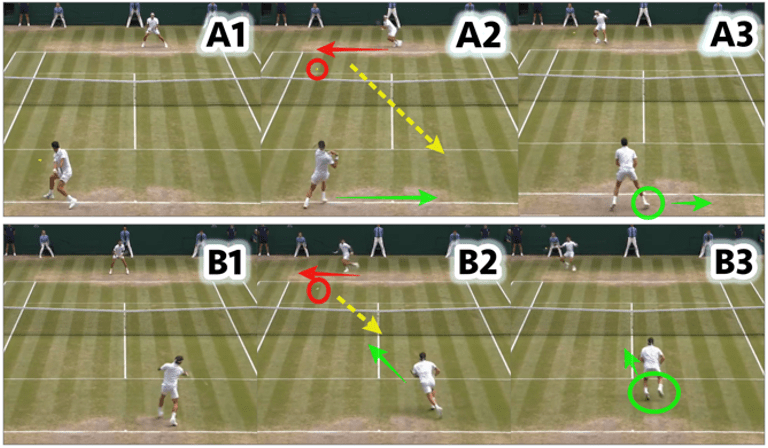
Figure 2. Observation of the hitter’s movement in direction and urgency
Figure 2 explains how the hitter (Images A1, B1), creates the earliest anticipatory transitional movement based on the opponents’ movement towards the impact point (Images A2, B2). Just before the impact point the split step is initiated with already determined direction and intensity of movement before the landing (Images A3 – to the right, B3 – to the front).
Following their strokes, the two receivers (players on the bottom in both A and B) detected the high urgency of the opponents’ movement response [KK3] [md4] (red arrow). By predicting limitations in the stroke options, they initiate earliest anticipatory movement response in lateral (Djokovic, green arrow, image A2) or forward direction (Federer, green arrow, image B2). In both cases the prediction was made based on the relation between the two moving bodies (hitter and a ball) and hitter’s impact position at the court. Based on the stroke direction and potentials in creating a forward momentum after the two bodies collide, receiver initiates the latest anticipatory (pre-contact) movement response from the split step (Images A3 – to the right, B3 – to the front).
[1] https://en.wikipedia.org/wiki/Momentum
[2] Oxford dictionary
[3] Cambridge dictionary
 Play Smart Tennis - MIND YOUR GAME - Anticipate! Don’t participate